Meta’s Generative Ads Model (GEM): Scaling the Central Model and Compute Engine for Frontier Ads AI
Meta says scaling a recommendation model LLM-style like a frontier model lifted ad conversions 18.9% and CTR 12%.
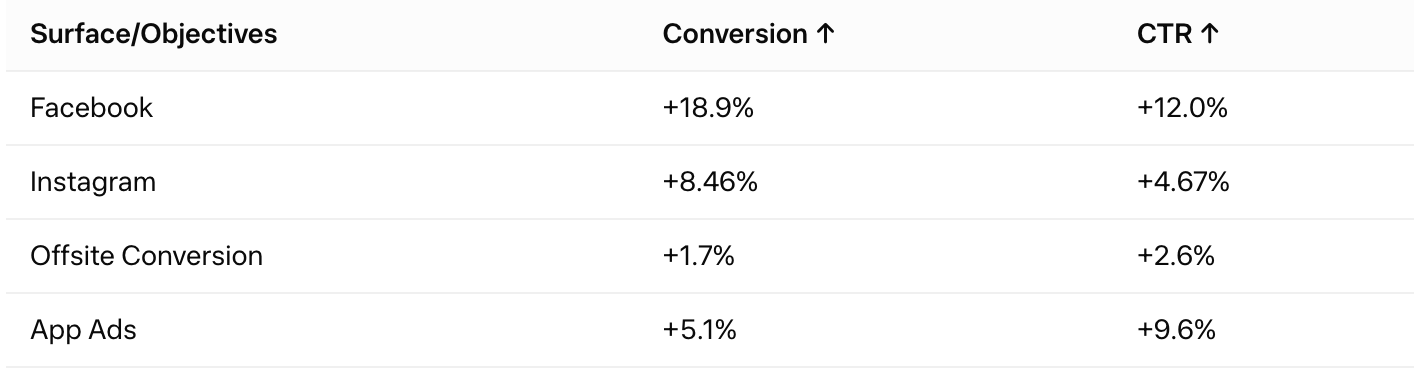
Meta published engineering details on the 2026 generation of its Generative Ads Model (GEM), unifying previously separate per-surface ad-ranking systems (Facebook, Instagram, Reels) into one central foundation model trained with an LLM-style architecture called Kunlun. Meta reports 2.5x model complexity growth, 4x total training FLOPs, doubled training efficiency, and claims 18.9% conversion and 12% CTR improvements across its ad surfaces.
Why it matters
This is a detailed engineering account of applying LLM-style scaling laws and architecture (attention, MoE, long-context sequence modeling) to industrial-scale recommendation/ads systems, an area that historically has not shown the same scaling behavior as transformers. It signals that scaling-law thinking and transformer-style architectures are being successfully adapted well beyond text generation, into large-scale ranking and recommendation infrastructure.
What is verified
Meta's 2026 Generative Ads Model (GEM) unifies previously per-surface ad prediction systems (Facebook, Instagram, Reels, etc.) into a single central foundation model. [1]
GEM delivered an 18.9% conversion improvement and 12% ad click-through rate improvement across Meta's ad surfaces and objectives, plus additional conversion uplifts of 5.8% on Facebook, 4.1% on Instagram, and 1.6% off-site for targeted users over the past year. [1]
Meta introduced a new LLM-style architecture called Kunlun, which it says delivers 2x performance gains over the previous architecture (Interformer) at the same computation scale, and observed a 2.5x model complexity increase from earlier GEM versions with LLM-like scaling behavior. [1]
Meta scaled total training FLOPs 4x while doubling end-to-end training efficiency to 20-25% model FLOPS utilization (MFU) across thousands of GPUs. [1]
A technique called CompSkip selectively deactivates sequence modules to reduce FLOPs by 43% with negligible quality loss, and a reformulation called GDPA delivers up to 2x forward speedup. [1]
What is not
- These are Meta's own vendor-reported figures with no independent verification or third-party benchmark comparison.
- No details on methodology, evaluation conditions, or how 'conversion improvement' and 'CTR improvement' were measured (A/B test scope, duration, significance).
- The underlying architecture (Kunlun) and infrastructure are proprietary to Meta's ads stack; no indication any of this is released or reusable outside Meta.
- No information on cost, hardware spend, or whether gains generalize beyond Meta's specific ad-ranking use case.
Sources
- 1Meta Engineeringengineering.fb.com · Primary source
Original source published 13 October 2026 at 18:01.
An AI-assisted briefing by Coding Partners. We link the evidence behind the reporting so you can explore the original work and assess the claims. How CP Signal works.